Friday, 14 March 2014

Catherine Review: Give Into Temptation

One of the main gripes people seem to have with the state of the video gaming industry today is that of ambiguity. There is a very narrow and blinkered view that the only games released are AAA grey and brown shooters or those games such as The Last of Us and Bioshock: Infinite that exist to tell a blockbuster tale with the same mechanical tropes as always.

These people need to play Catherine.

The best way to describe Catherine is that it's a Puzzle game with a gripping and insane story at its core; made by Atlus, it manages to balance gameplay with impressive story telling techniques which feel slightly reminiscent of the Persona series for obvious reasons. Now although this sounds similar to the type of game I was describing above, its the addictive puzzles and the content of the story that really makes this sleeper hit such a stand-out title for me.

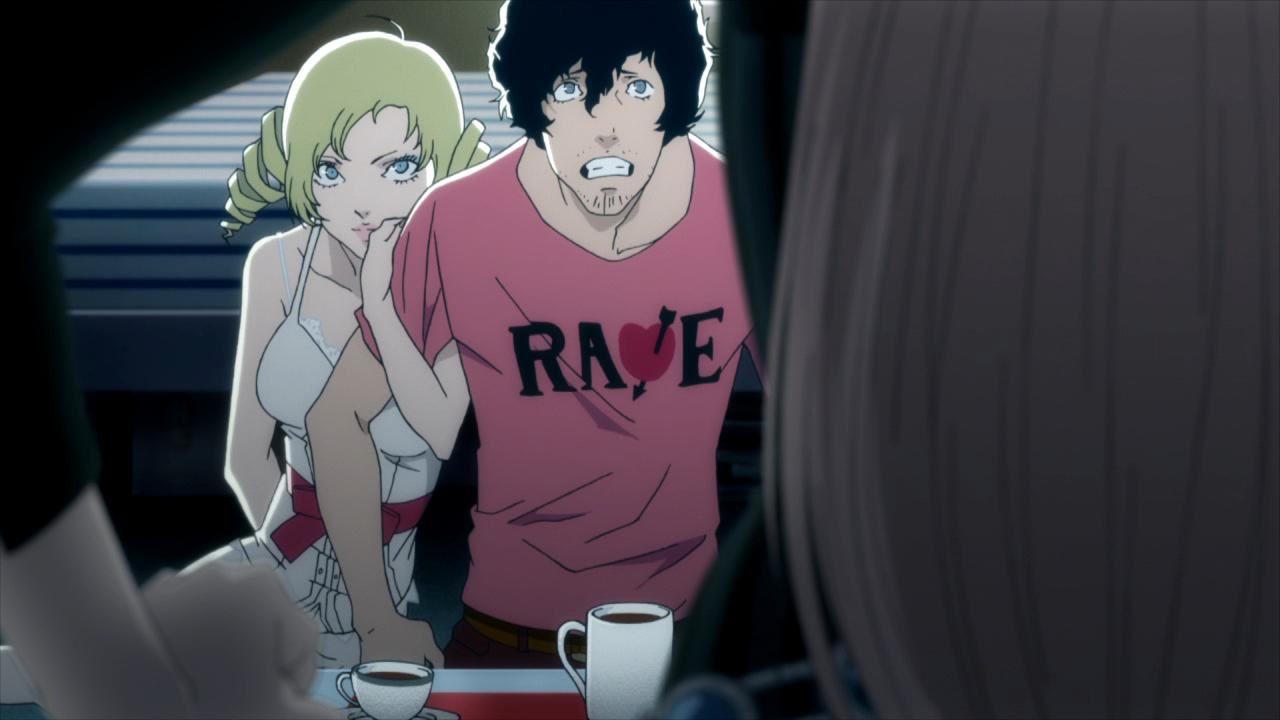
You are Vincent; a thirty-something year old who has a long term girlfriend called Katherine. She is slightly controlling, highly strung and quite boring, but Vincent loves her, she is grown up and represents his commitment to being a adult. Recently, Vincent has changed jobs to a low paid but enjoyable role and has started to question whether he is ready to settle down. He spends every night with his group of friends at the local bar until one night when he wakes up with another woman (Catherine) in his bed.

Then he starts having nightmares.

Temptation or Fate?

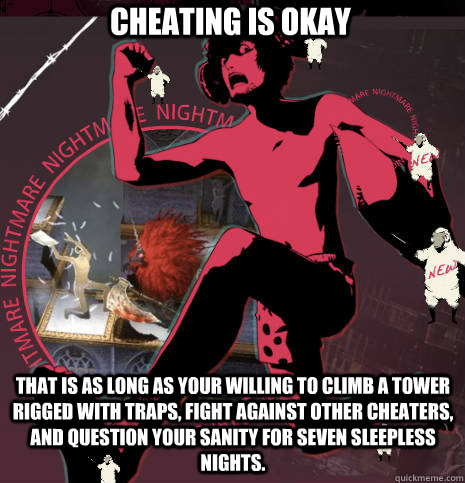
The game is best described as 50% Visual Novel, 50% Puzzle and these nightmares are where the latter half of the game takes place. Vincent and hordes of sheep must pull, push, climb and fall their way up a wall of blocks before it collapses beneath them to escape the nightmare; working against each other and in some levels a giant manifestation of Vincent's innermost fears that is giving chase. If Vincent or the sheep fall, but don't wake up before they hit the ground, they die in real life.

It's extremely difficult to describe, but perhaps one of the most interesting puzzle games I have played; there are so many methods to beating the same level and it feels satisfying to ascend the wall to the very top, knowing that when you do, you get to talk to the sheep representations of the people you interact with in the 'real' world to find their inner secrets that you know that they're hiding from you.

Catherine keeps each stage varied by providing a series of variant blocks that change the dynamic and feel of each level; keeping you on your toes and suitably frustrated. After the first level things can get extremely complicated - I had to wheeze it up on easy mode by the end as I just couldn't take the feelings of inadequacy any more. However that's part of the enjoyment; the satisfaction of solving a puzzle and feeling like a genius - reminiscent of the rush you get from defeating a boss in Dark Souls or getting a good result from a really difficult piece of project work.

An example of the rather unique gameplay

Not only does the title have the story mode, it adds more 'game' to the cooking pot via the arcade machine in the bar you frequent every night called "Rapunzel" where the same principle as in the nightmare sequences is applied. Ontop of this, you also have 'Babel' mode for 1 or 2 players where random block sets are in play which prevent you or your partner from planning ahead; you work co-operatively to climb the tower together. Finally there is the 'Colosseum' mode which is a competitive, local split-screen variant of the puzzle aspect that requires you to race against the second player to be the fastest to climb to the summit of the tower. All add considerable length and replayability to the game and are a joy to play for hours after you have finished the main story.

But the great part of the title is the way that it strings you along. It's an extremely impressive piece of game design as the more Vincent strings along both of the women in his life, the more invested in the story you are. So when it drip feeds you cliffhangers every night, it makes you want to press forwards. But you can't until you've finished the series of puzzles in the nightmare phase. The game toys with you as much as your character and decisions do in the story, and makes you feel like the ignored partner that suspects the game of cheating on you, by pushing you to one side every time you get a gleam of the possibility that it is going to open up to you and confess its secrets.

On the flip-side however it can also be a big agitator. I found that the more the game went on, the more I wanted it to morph into a pure visual novel rather than a puzzle hybrid. It wasn't because of the lack of depth or the difficult puzzles, but more the fact that I loved the story so much, I never wanted the progression to end; rather than sudden walls that were raised after it just got good. It felt very jarring at times that something interesting would happen, then you couldn't follow that lead until you left the Stray Sheep bar and went to sleep.

Whilst on the subject of frustration, the controls in the puzzle sections of Catherine seem to actively work against you; sometimes performing twice the amount of movements that you wanted, or moving a block in the wrong direction which can cause you to have to reset the entire level. Additionally, the controls also killed me multiple times as you are required in some nightmares to move around the far side of the wall. Apart from not being able to see Vincent, the game reverses the buttons but in a strange way; forcing you to lose time to an unfortunately confusing mess of presses to get him visible again.

"Vincent, I'm sorry but you have to go around the back of the tower again."

Although I say this, Catherine still does plenty more to make this up to you. The soundtrack both whilst in nightmares and in the Stray Sheep bar for the story scenes is once again a fantastic treat from Atlus that like I said in my Madworld review, had me humming the songs long after I had stopped playing. The combination of well written characters that you care about along with this soundtrack can cause some great moments; whether you're browsing your phone and receiving dirty text messages from your mistress, talking to the weird and wonderful characters of the area or rehearsing the "techniques" mentally that you are shown by the sheep in the dream world every night. There is a heavy emphasis on atmosphere in this title and it benefits greatly from it.

Visually, this is almost a clone of the Persona games; I feel bad using them as a comparison, but it's just true. You can take a single look at the cartoony and overly exaggerated characters with the slightly more photo-realistic scenery and see that the individual feel of the games has carried over to make this feel like an extension of the series.

Independently and for those who haven't played a Persona game, the graphics are cel-shaded and characters personality traits are placed at the forefront of their appearance. The surroundings in the game are cartoony, but just appear to be photographs with a light artistic filter applied on them. Along with fantastic anime cutscenes, this is a gorgeous mix of visual elements and is unlike anything you'll see anywhere else.

But finally, perhaps the most important thing to mention about Catherine, is how it's a game that makes you question your own morality. It's a lesson in the fact that we all take our morals from the environment and culture around us, but challenges you on that matter. It allows you to make choices on whether you favour your long term girlfriend Katherine, if you prefer the new and exciting Catherine or if you just enjoy playing them both off against each other in some interesting ways that I will not spoil. It genuinely made me consider why I feel that cheating is wrong from the way it portrays Vincent's life and inner monologue; but by the end and due to the decisions I made, showed me exactly why I have the views I do on the matter.


It's a game that will stay in my mind for a very long time and an experience I recommend everyone to try. I was given it for free through PS+ (EU) but it can be picked up extremely cheaply for around £14/$20; more than worth the price of admission if you're looking for something new to try, but have been patient.

8/10

Wednesday, 12 March 2014

Catherine. COMPLETE.

Wow.

Just wow.

What the hell did I just play?

I think it was a game about a man cheating on his girlfriend and then having a dream that he's a sheep that has to stack blocks to prevent falling to his death every night.

Not even scratching the surface with that.

I'm not even sure what I felt about this title, so I'm going to take a day or two so that I can gather my thoughts on it, then I'll do a write up.

On to the next one!


Monday, 10 March 2014

The Hidden Secrets of Your Video Game Case

What if I told you that when you walk into a video game shop or browse a retailer online, they are trying to sell you something?

"HOGWASH!" I hear you cry; women and children fainting left and right from disbelief.

Well it's a fact, video games are products, and a large part of the sale publishers need to make stems from video game box art.

As a result, features and awards are plastered across the front of the boxes, forcing the characters and scenery to gasp for air, begging you to buy them.

So you take the box to the till, pay for it and walk off. But the box is still an ugly sales tool when you get home and take it out of the carrier bag. Hurray for capitalism.

Or is it?

Let's take two great games and show you what the marketing cover looks like:


These aren't terrible examples of clutter, but I find them pretty ugly as you have the logo's of the game studios that made them, the publisher, age rating at it's statutory size etc... as well as all of the blurb of the game on the back. Necessary before the sale, but afterwards....?

But most of your cases actually hold an awesome and from my experience, well kept secret. Let's take a look:


Firstly, open up the box and remove the manuals/dlc codes to reveal the secret art hidden inside. This is what the box artist actually wanted you to see, but still; it's facing inwards and not doing you any good there.

What you need to do is open the box all the way out flat so the outside is facing you. Then take out the cover from behind the plastic sleeve, turn it round so the inside you just saw is now facing outwards and replace it so it looks like the following images:


This is the beautiful and real case cover. Sadly not every game is like this, such as most EA titles (the mass produced EA games such as Fifa etc...). It shows a great deal of care and attention on the teams part and I think a great touch that can turn your shelf full of noisy and busy shelf of games into a beautiful mural of video game art.

Bonus points if the nice design fits on the front cover:


I hope you enjoy hunting through your PS3 games and some PC games (don't believe that 360 games do this) to find these gorgeous hidden gems.

Let me know of any games you find that has been hiding it's inner beauty from you in the comments section - and as always, if you like the posts, please feel free to like it, share it, tweet it etc... It helps a lot!

New Week, New Games! Volume 2

Now that The Last of Us has been dealt with and my co-op play-through of Borderlands 2 is nearing towards an end, I've decided that today I'll be embarking on a couple of new journeys.

The universes I'll be exploring this week are:

Brutal Legend
Genre: Action
Platform: PC
Length: 12 Hours

Literally all that I know about this game is that it's made by Tim Schafer and has Jack Black as the protagonist. Other than that I'm clueless. From the cover I expect it to be a story about a mystic guitar and it's quest to overshadow medieval war axe archetypes.

I'm hoping for plenty of 'School of Rock' references.


Catherine
Genre: Puzzle
Platform: PS3
Length: 17 Hours

Once again; no idea about this title. All I know is that it's about a man's guilt after having a one night stand with a woman called Katherine (with a K). Rather optimistically, I'm hoping for it to be a nice change of pace from the action based games I've been enjoying lately.


I'll be sure to write my first impressions if they're anything unusual!

Sunday, 9 March 2014

The Last of Us Review: It's the End of the World as we Know it

There's a certain poignancy about the end of the world that I think everyone can relate to; deep down inside we all wonder what would happen if we were alone in the world and didn't have to take part in the regular 9-5 routine. This is what The Last of Us seeks to tell a story about; survival at it's utmost rawness, kill or be killed, live to carry on living, and oh boy does it get that oh so right.

The atypical video game seeks to wrap a great story around great gameplay and form a balance that allows users to feel immersed in the world - creating an interactive movie of sorts that people can lose themselves in. In the best of cases, it is difficult to separate these two dynamics, you enjoy both and shouldn't feel a disconnect between what you're controlling and what you're watching.

Sadly, for me, The Last of Us made me wish every step of the way that it was more of a 'Heavy Rain' esqué game, where you could get from A to B at your own whim without being dogged by repetitive and sometimes what felt like artificially difficult mechanics.

And yes, most of the time, the enemies are incredibly stupid.

Without delving too far into the story as to avoid spoilers, The Last of Us revolves around Joel; a man who lost everything, like many others when a fungal infection broke out and turned the majority of the world's population into murderous monsters, as well as facing people against each other gradually due to the need for resources. Joel is then given a task to transport Ellie, a young and very real character across the transformed United States for purposes unknown. Cue one of the best stories ever explored by an entertainment medium and a showcase of why video games are one of the fastest growing and most exciting art forms in existence.

Having been released towards the end of the last console generation, The Last of Us is quite impressive visually; normally when you think of how a dead planet looks in these kind of titles, you think of greys, browns and blacks. This game paints a colourful and believable repertoire of scenery, characters and objects that have all been aged to perfection and assembled in a way that frames Joel's quest in city streets, sewers, decrepped buildings, forests and other outstanding places, making you wish you could wonder freely, rather than being constrained with the industry's current obsession with funnelling the player in a set route and putting blinkers on what you can see and do.

Cities have quite literally become an urban jungle.

Another complement to the story is The Last of Us' OST; an emotional and breathtaking set of melodies that really set the scene and evoke feelings on demand. As a tool they could not have done any better, when the credits rolled and the final song played, I felt empty and drained but with the remnants of happiness from the memories I had that this song was drawing from me. The composers and musicians are to be complemented and regardless of whether you will play the game, you should take a listen to the music and hear the brilliance for yourselves.

The main gameplay mechanics in this title revolve around sneaking, shooting and platforming, normally in that order and in a cyclical fashion. This is due to the apparent obsession the game designers have with enemy encounters - you'll be wandering around and gathering supplies; reading letters from suitcases with a skeleton still grasping hold of it, detailing a person's frantic attempts to find his family and get home - feeling empathy and being drawn into this desolate world when predictably, you'll hear voices, or the clicking sound that indicates that your fungal friends are ahead.

Please do not mistake me in thinking that I'm saying that they never get it right, as Naughty Dog have proven that they are the masters of creating atmosphere in this game; quite a few scenes had me frantically running and sneaking around enemies to get to the objective before I was found, and had me backed into a corner with a shotgun, rapidly spamming R1 to kill everything coming my way in a fear that truly gripped me. But unfortunately most of the actual game revolves around you either killing or sneaking around X amount of enemies to get an object or to get through a door before the game forces you to kill them anyway. It's extremely sad as it's so noticeable, in some scenes, it slightly ruined my experience, although it others it added to it, it's quite hit and miss and based heavily in the context of what is happening in the story at the time.

Sometimes the game leaves you with no option other than to panic and waste ammo. Clever.

This is not to say that the designers haven't tried to make the actual game sequences more fleshed out; there is a crafting mechanic for weapons that has you searching for scrap in the scenery and an upgrade system that can improve Joel's powers, even if this is just by taking large amounts of pills found lying about. Ultimately however, these feel slightly redundant as resources are so scarce and enemies are so many, in some cases I literally just sprinted past all the enemies are ran through the door with no consequence and a feeing that they were supposed to feel more sinister than they were. In fact after a while, due to the repetitiveness, enemies stop feeling like genuine threats and start feeling like barriers to your end goal, either worryingly bad for this type of story based title, or extremely clever on the writers side - forcing you to kill or avoid enemies to survive. I'll leave that to your interpretation.

I actually found that for most of it, I was butting my way through the actual game just to get from cutscene to cutscene, something that imbalanced the gamer in me slightly as I felt that the two elements should work in unison, not fight with each other or encourage one to be worse or superior than the other.

But it's this theme of duality that works beneath the surface of the story itself that I think the game is trying to put across. Joel is a broken man; fighting internally between his need for survival and his need to feel something, the part of him that makes him human rather than a psychopathic murderer - something I think the game actually approaches very well, even at one point showing that murdering literally hundreds of people has an effect on how people see you.

The eyes of a psychotic killer, or the eyes of a desperate survivor?

The gameplay is the survival aspect of Joel's personality; necessary, rough and repetitive - showing the fact that humans need to do certain things in this world on a regular basis to stay alive. Survive this situation, survive that situation. Rinse and repeat. Whereas the cutscenes represent Joel's emotional side; his capacity to feel is emphasised through the emotions conveyed to the player, performed in a way I've never seen done before in a video game, varied experiences, intense and emotional dialogue and gorgeous framing that shows another need for humans in this post-apocalyptic world.

It truly sets a standard for how amazing stories can be for the industry, and it's writing like this that will allow this art form to be taken seriously in the future, rather than simply being something with certain negative stigmas and stereotypes. Characters you favour are ripped from you, characters you hate aren't bought to proper justice, you laugh, you cry, you feel happy, angry and every emotion under the spectrum, leaving you gasping for more by the time each cutscene ends; something that is somehow pulled off so much better than most AAA blockbuster movies have been in modern times.

As I finish this quasi-review, I can't help but think to myself that this is exactly why I set out to finish my backlog; to experience the stories and new worlds video games can offer, in a way that many other forms of entertainment can't. I came back to this title after becoming so frustrated with it that I couldn't bring myself to play any more; now relieved as I have ever been that I saw fit to come back to it and push my way through. No matter how bad some parts of the experience were, I will always remember The Last of Us as part of my gaming renaissance; the title that reminded me why I play video games and why the games I finish are the ones with an amazing story versus gameplay gimmicks.

8/10

Friday, 7 March 2014

The Last of Us. COMPLETE.

So after the second attempt at finishing this game, I've done it.

The credits are rolling as I type this and my feelings about this title are so very mixed. It's going to be interesting to see what I think of it as I write it up.

I'm just amazed and proud of what the video game industry can do for story-telling. Shame about the actual game in this case.

Expect a review by the end of the week.


Thursday, 6 March 2014

Mad World Review (Wii): I Find it Kind of Funny...

The Wii as a console left a legacy of wishy washy bloatware titles full of mini-game collections and movie tie-in games that weren't worth the plastic they were printed on; leaving a bad taste in many of the Nintendo loyal who had invested their money and time in waiting for the killer game to own the console for. In saying this though, there were a few games that genuinely deserved a chance to get their head above the water and be recognised as decent and enjoyable.

Mad World is one of these attention deprived sleep successes (not in sales), in that it's a cheap and enjoyable roller-coaster ride of obscenity; be it gore, crude jokes and partial nudity, Platinum Games have created the anti-thesis of a Wii game.

Mario on his off day

This isn't to say that it isn't perfect for the Wii however. Although the market is clearly miniscule for an 18 rated game on a family console, it still should have sold better than it did, mainly for its unique style and mechanics that were designed for the wand and nunchuck, as opposed to the vanilla range of Mario titles that have turned a company once known for their innovation into ranchers that are merely prodding a cash cow.

Mad World is an ultra violent, proto-arena based beat-em-up game set in a black and white cel shaded world where Jefferson Island (New York) has been sprayed with a deadly virus and the only way to get a vaccine is to take part in the "Death Games". The resulting situation is where neighbour kills neighbour and gangs from around "contestants" (the best psychopathic killers) who are given ranks; the higher the rank, the more the contestants are paid.

Enter "Jack" - the playable character, a man who has been sent onto the island for mysterious reasons to become the #1 contestant. With one iron arm and an extendible chainsaw mounted on it, he punches, throws, stabs, tears and saws his enemies apart one by one in open arenas, where each kill scores points. When your points are at a certain level, events unlock that allow you to kill more creatively and ultimately follow onto to a boss battle with the next 'contestant', so that you can progress to the next arena, then the next, then the next, rinse and repeat.

This repetitive nature of the game is essentially the biggest issue with it - you are killing people and fighting the boss so that you can kill more people and fight another boss. This is essentially what all video games boil down to, however most go to more effort to hide this fact or at least sweeten it up with some variety in enemy types or added abilities. Not to say that Mad World doesn't try though; some levels have unique foes that have special abilities such as a 'one touch death' attack and weapons are bestowed onto the player to try and vary how Jack feels when controlled.

On the subject of controls, the Wii was a great choice when Platinum Games were thinking of making this game - waving around the wand and the nunchuck feels like a perfect compliment to the madness happening on screen and Jack seems to react well to the commands given to him, apart from in some of the mandatory quick time events. Sadly, the game does come down to waggling the controls around wildly in bigger fights, however the fun from the combat comes from using the environment to kill enemies in often hilarious and satisfying ways. But after you have mastered the arena and mapped it out mentally, it becomes a stale routine of picking up and throwing enemies into meat grinders and saw blades just to get enough points to finish the levels.

The visual design of Mad World as mentioned is a slightly jaggy black and white cel-shaded world, only interrupted by bright red splatters when enemies are attacked and killed. The enemy appearance varies wildly, but sadly is not very good at hiding their very similar attack patterns and abilities. The bosses however are very well created; all extremely different and all better off for it. They follow the theme of the level and are memorable for their overly stylised appearances and adherence to overemphasised cultural stereotypes, only adding to the wild and wacky comic book appeal of Jack's adventures in New York.

What's black and white and red all over?

Where Mad World truly shines is the application of the sound design - something Platinum Games is very well known for; in this case they definitely deserve a round of applause. You'll literally never hear a soundtrack like it; people spitting out words at high speeds to a techno-rock-rap track which literally never gives you a respite. It compliments the gameplay to no end, urging you to continue so that you can see how the track will evolve at the different events and the boss battle; leaving you humming the last level's track in the loading screen for the next.

This is exactly the brilliance of Mad World - I would liken it to a tube of Pringles; you take the first bite and enjoy it so eat more of them, then between bites think how good they taste, until you get about half way and realise that they are all the same. But just like Pringles, you think "eh... I'll just finish them anyway." A video game in every sense of the word, Mad World is a fun Theme Park of action that deserves a play if you can pick it up cheaply.

6/10